

Moles Removal Specialist in Stockbridge, GA
Discovering a new or changing mole can be a source of significant anxiety, but professional evaluation is the first step toward peace of mind. At Bella Dermatology, we provide removal services to ensure your skin remains healthy and your concerns are addressed with clinical precision. Led by Dr. Terry Sharpe, MD, our clinic utilizes advanced dermatoscopy to distinguish between benign growths and those that require medical intervention. For more information, contact us or request an appointment online. We are conveniently located at 1365 Rock Quarry Rd, Suite 300 Stockbridge, GA 30281.
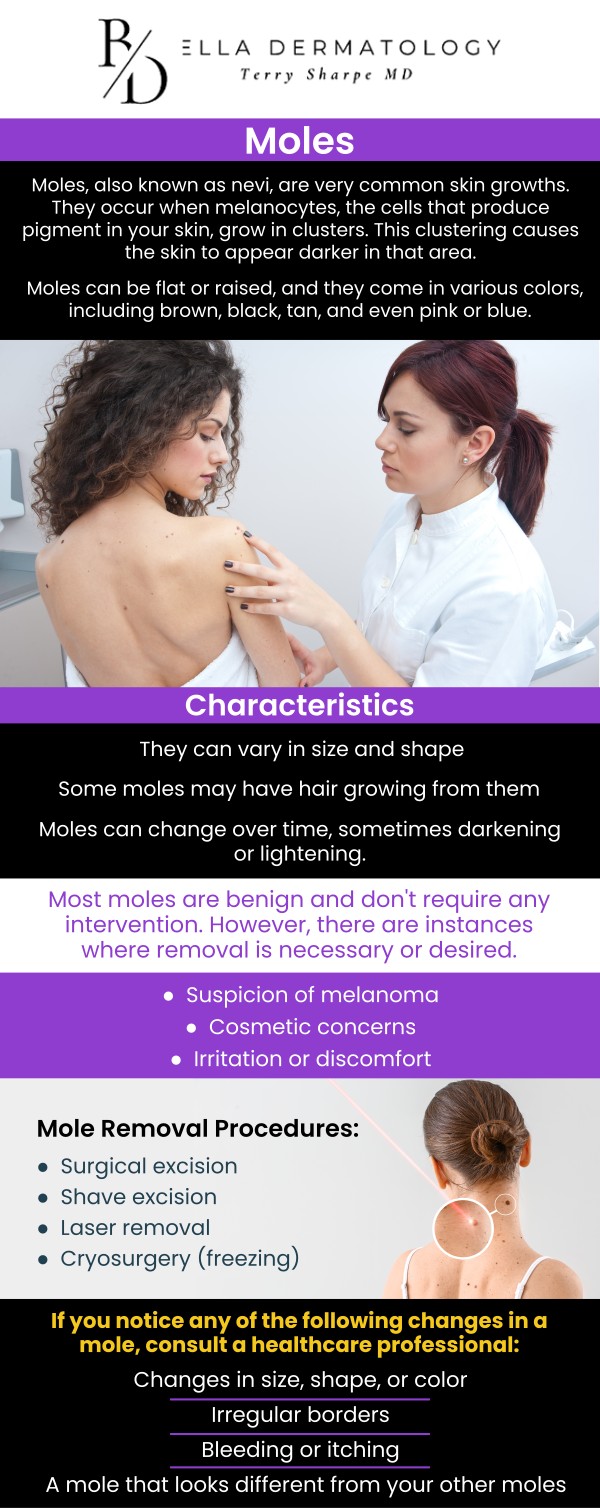
Table of Contents:
How can you tell if a mole is normal or cancerous?
What are the common types of moles and how do they differ?
When should you see a dermatologist about a mole?
Can moles change over time and what does that mean for your health?
Professional Mole Evaluation and Removal with Dr. Terry Sharpe at Bella Dermatology
While self-exams are vital, they do not replace the expertise of a trained specialist. You should schedule an appointment at Bella Dermatology if you notice any “ABCDE” changes, but there are other physical symptoms that require a Dr.’s attention:
• Sensory Changes: If a mole suddenly becomes painful, tender, or itchy.
• Surface Changes: If a previously flat mole becomes raised, or if a mole starts to ooze, bleed, or develop a scaly texture.
• New Growths: If you develop a new mole after the age of 30, it should be screened, as most benign moles appear earlier in life.
• High-Risk History: If you have a personal or family history of skin cancer, or a history of frequent sunburns, you should receive a professional full-body skin exam annually.
Distinguishing a common mole from a potential malignancy requires a keen eye and a systematic approach. Most “normal” moles are uniform in color (usually brown or tan), have distinct borders, and are smaller than six millimeters. To help patients monitor their skin at home, Dr. Terry Sharpe recommends using the ABCDE method, a clinical guideline for identifying suspicious features:
• A – Asymmetry: One half of the mole does not match the other in shape or texture.
• B – Border: The edges are irregular, blurred, notched, or “scalloped” rather than smooth.
• C – Color: The mole contains multiple shades of brown, black, or even patches of white, red, or blue.
• D – Diameter: The spot is larger than 6mm (about the size of a pencil eraser), though some melanomas can be smaller.
• E – Evolving: The mole is changing in size, shape, color, or elevation, or it begins to itch, crust, or bleed.
At Bella Dermatology, we also look for the “Ugly Duckling” sign—a mole that looks significantly different from all the other spots on your body. If a mole stands out from its neighbors, it warrants a professional examination.
Not all moles are created equal, and understanding the different types can help you better monitor your skin health. Most moles fall into one of three categories:
• Congenital Moles: These are present at birth. While most are harmless, very large congenital moles may have an increased risk of developing into melanoma later in life.
• Acquired Moles: These appear during childhood and adulthood, usually due to sun exposure. Most people have between 10 and 40 of these common moles.
• Atypical Moles (Dysplastic Nevi): These moles are often larger than average and have irregular borders or multiple colors. While they are not cancerous, having many atypical moles increases your overall risk for melanoma.
During your visit to our Stockbridge office, we use specialized tools to look beneath the surface of these growths, ensuring that any atypical features are documented and monitored or removed if necessary.
While self-exams are vital, they do not replace the expertise of a trained specialist. You should schedule an appointment at Bella Dermatology if you notice any “ABCDE” changes, but there are other physical symptoms that require a Dr.’s attention:
• Sensory Changes: If a mole suddenly becomes painful, tender, or itchy.
• Surface Changes: If a previously flat mole becomes raised, or if a mole starts to ooze, bleed, or develop a scaly texture.
• New Growths: If you develop a new mole after the age of 30, it should be screened, as most benign moles appear earlier in life.
• High-Risk History: If you have a personal or family history of skin cancer, or a history of frequent sunburns, you should receive a professional full-body skin exam annually.
It is natural for moles to undergo slow, subtle changes over decades—they may grow slightly hairier or slowly fade. However, rapid changes are often a biological “red flag.” When a mole evolves quickly, it suggests that the cells within it are dividing at an abnormal rate, which can be a precursor to skin cancer.
An evolving mole doesn’t always mean cancer, but it does mean your skin’s equilibrium has been disrupted. Factors like hormonal shifts (such as during pregnancy) can cause moles to darken or enlarge, but these changes should still be cleared by a professional. By tracking these shifts at Bella Dermatology, we can intervene at the earliest possible stage, which is the most critical factor in successful treatment and long-term health.
At Bella Dermatology, we believe that proactive care is the best medicine. Dr. Terry Sharpe approaches every skin exam with meticulous detail, ensuring that no spot goes unnoticed. Dr. Sharpe understands that the decision to remove a mole—whether for health reasons or because it catches on clothing and causes discomfort—is a personal one. She utilizes various techniques, from surgical excision to shave removals, to ensure the best aesthetic outcome with minimal scarring. For residents in Stockbridge, GA, her clinical expertise provides a bridge between rigorous cancer prevention and high-quality aesthetic care. You can trust that your skin is being monitored by a specialist dedicated to your safety and confidence.
Your skin is your body’s largest organ and its first line of defense; keeping a close eye on your moles is a vital part of its maintenance. At Bella Dermatology in Stockbridge, GA, we are here to provide the removal services you need to stay healthy and worry-free. If you have a mole that has changed, or if you simply want the peace of mind that comes with a professional skin check, don’t wait. Contact us today or schedule your consultation and let us help you protect your skin’s future. We are conveniently located at 1365 Rock Quarry Rd, Suite 300 Stockbridge, GA 30281. We serve patients from Stockbridge GA, McDonough GA, Jonesboro GA, Morrow GA, Ellenwood GA, Hampton GA, and surrounding cities.
Check Out Our 5 Star Reviews


Additional Services You May Need
• Acne Treatment
• Eczema Treatment
• Skin Cancer
• Skin Rejuvenation
• Skin Rashes Treatment
• Psoriasis Treatment
• Moles Treatment
• Wrinkles Treatment
• Wart Treatment
• Microneedling
• Rosacea Treatment
• Laser Hair Removal
• Skin Tightening
• Chemical Peels
• Melanoma Treatment
• Pediatric Dermatology
• Dermatological Surgery
• Adult Dermatology
• Annual Skin Exam
• Customized Skincare Regimens
• General Dermatology
• Sofwave Skin Tightening
• Dermaplaning
• Aerolase Laser
• Pediatric Eczema

Additional Services You May Need
• Acne Treatment
• Eczema Treatment
• Skin Cancer
• Skin Rejuvenation
• Skin Rashes Treatment
• Psoriasis Treatment
• Moles Treatment
• Wrinkles Treatment
• Wart Treatment
• Microneedling
• Rosacea Treatment
• Laser Hair Removal
• Skin Tightening
• Chemical Peels
• Melanoma Treatment
• Pediatric Dermatology
• Dermatological Surgery
• Adult Dermatology
• Annual Skin Exam
• Customized Skincare Regimens
• General Dermatology
• Sofwave Skin Tightening
• Dermaplaning
• Aerolase Laser
• Pediatric Eczema


 Send Text
 How May I Help You?